
The Agent-Native Enterprise
Summary
Enterprises are approaching a tipping point where software agents will outnumber human employees by 100:1 or more. When that happens, agents — not people — become the primary consumers of the entire software stack. Organizations that re-architect their tools, APIs, business models, and infrastructure for an agent-first world will pull ahead; those that don't will find their systems effectively invisible to the workforce that matters most.
The shift
A year ago, agents were chatbots with basic tool access. Today's agents operate in sandboxed compute environments, write and run their own code, interact directly with APIs and CLIs, maintain persistent file systems and long-term memory, and can sustain multi-hour autonomous work sessions. The architecture that emerged from coding agents has now crossed into knowledge work, personal productivity, and continuous 24/7 autonomous operation.
The consequence is straightforward but far-reaching: nearly every economically valuable task in an enterprise — contract review, customer support, financial audit, drug discovery research, code generation, sales deck creation, presentation design — will have an agent involved in its execution. And critically, agents won't just do what people already do. They'll run simulations too expensive to attempt before, prototype every idea with dozens of variations, pursue far more projects because start and teardown costs are near zero, and review complete datasets rather than samples.
When you sum the economics, the math points to a ratio shift: every knowledge worker will have many agents operating on their behalf. An enterprise with 100 or 1,000 times more agents than people is not speculative — it is the natural endpoint of these capability and cost trajectories.
Why it matters
Most enterprise software was designed for human users: GUI-first, seat-licensed, with sign-up flows that require a browser, a password, and a human decision-maker. In an agent-first world, those design choices become existential liabilities.
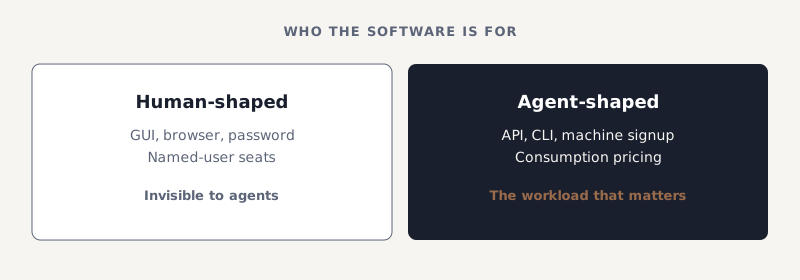
If an agent cannot sign up for your service via API, your service does not exist to that agent. If your features are not exposed through a CLI or MCP server, they might as well be hidden. If your pricing requires a named user seat but the work is being done by a headless agent with no human counterpart, you have a unit-economics problem.
This creates a structural challenge for every enterprise software vendor and internal platform team. The tools that are easiest for agents to adopt — clean APIs, straightforward authentication, programmable account management — will capture the agent workload. Agents do not attend webinars, click ads, or read sales collateral. They will simply use the best tool for the job. The question for every platform owner is whether that tool is yours.
The business model implications are equally significant. A single short prompt from a human can trigger hours of agent work inside software, with the agent exposing only the final output. Seat-based pricing breaks down in that model. Consumption-based or volume-based pricing becomes the only viable structure — and agents may need the ability to transact autonomously, making wallet infrastructure and programmable payments a core enterprise capability.
What to do
Make everything API-first. If a feature has no API, treat it as if it doesn't exist. Every function an agent might need — account management, data access, workflow execution, payment — must be available programmatically. The usability bar that historically applied only to UX design must now apply equally to API design.
Design for agent onboarding. An agent needs to sign up, authenticate, and configure itself without human intervention. This means programmable account creation, OAuth flows designed for machine clients, and credential management that works in automated environments. Put all account management functions behind APIs — anything else is effectively a blocklist.
Adopt consumption-aware pricing. Evaluate where seat-based models create friction in an agent-heavy workload. Volume-based or transaction-based pricing aligns cost with value when agents operate at variable scale. Support agent-initiated payment flows as a first-class capability.
Build agent infrastructure into your enterprise architecture. Agents need sandboxed compute environments, persistent file systems, identity and authentication mechanisms, governed data access, activity logs for compliance, and budgets they can draw from. These are not separate concerns — they form a new platform layer that sits alongside existing IAM, data governance, and infrastructure stacks.
Prepare for governance at agent scale. When agents execute regulated workflows — in pharma, banking, insurance — every action must be auditable, retainable, and attributable to a specific agent identity. This demands new governance frameworks that sit between existing human-oriented compliance systems and the new agent workload. Invest in agent identity, permission scoping, and activity retention as early architectural choices.