
The Uneven Diffusion of Agents
Summary
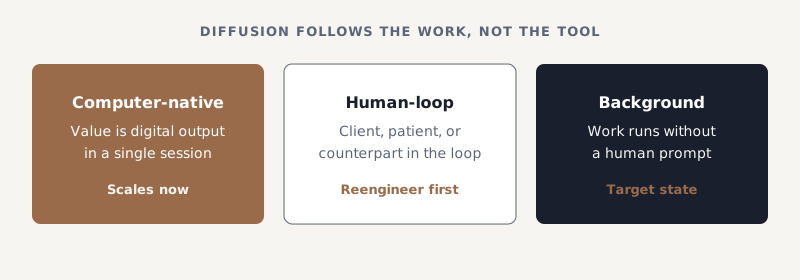
Agent diffusion will not be uniform across the economy. Some workflows are naturally aligned to continuous, uninterrupted computer work — and those are already going vertical. Others require human feedback loops, client interaction, or physical-world contact that today's agent model does not natively serve. The difference in diffusion rates is not random; it maps directly to how much of a workflow can be executed entirely inside a computer.
The shift
Consider why agentic coding has grown so fast relative to every other domain. Coding is a type of work where economic value is directly correlated with the output of solely digital information, and where task size can in theory be unbounded in a single session. As agents can handle larger amounts of work at a time, and as model capability improves, they can be deployed at larger workloads near-instantaneously. The entire value chain — spec, implementation, test, deploy — lives inside the machine.
Most work does not have this property. A sales representative needs a feedback loop with the customer before they can do additional work for a specific account. A lawyer needs to talk to the client. A doctor needs to interact with a patient. These are not friction points to be optimized away; they are constitutive of the work itself. Large-scale agentic work in these domains will not look like it does in coding, at least not by default.
A useful diagnostic: what happens if everyone calls in sick? In the current state of agent deployment, token usage would plummet — because nearly all agent activity is still driven by human prompting. Agents are not yet running autonomously in the background for most processes. This reveals how early we are in the transition. The majority of agentic work, in the long run, should be background continuous processing — not human-triggered prompts.
The opportunity is in the reengineering, not in the prompting. In legal, the target state is agents that process every incoming contract, not just the ones a lawyer explicitly hands off. In sales, agents that roam through customer records and surface signals for better outreach. In life sciences, swarms of agents reading through every research output and test result. To get there, business processes must be wired up to support agents — the vast majority of today's work is manual, unstructured, and designed for human cognition, not machine execution.
Why it matters
The uneven diffusion of agents has direct implications for who captures value. The coding vertical is already saturated with agent tooling. The real opportunity is in the workflows that require reengineering — sales operations, legal processing, life sciences research, financial reconciliation, clinical documentation. These are not markets where a generic coding-assistant product can be dropped in. They require understanding the workflow, redesigning the feedback loops, and building the integration layer that connects agents to human decision points.
This also means the diffusion curve for agent adoption will look different from past technology waves. SaaS diffused relatively evenly because the interface was a web browser — every knowledge worker has one. Agents diffused unevenly because the interface is the workflow itself, and workflows vary dramatically.
The common mistake is to measure the current state and conclude the opportunity is small. The correct frame is to ask: which workflows, once reengineered, become capable of continuous background agent operation? That set is much larger than the set of workflows that work with agents today.
What to do
- Identify workflows where the entire value chain lives inside digital information — those are your fastest paths to agent deployment
- For human-loop workflows, invest in the reengineering: redesign feedback loops, not skip them
- Build toward background continuous operation as the target state, not human-triggered prompts
- Design agent systems with the assumption that most work happens without human attention, and exceptions escalate appropriately
- Benchmark progress by the share of agent activity that runs unattended — that is the real measure of diffusion