
The Agent Deployment Services Wave
Summary
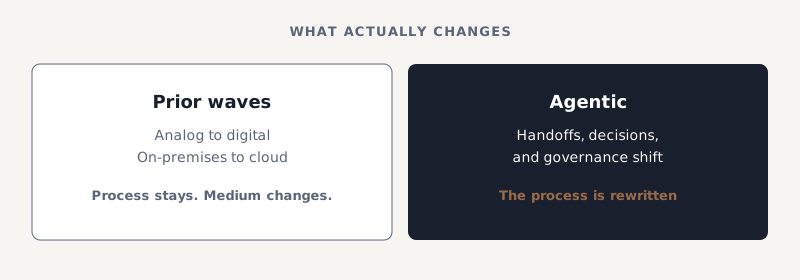
The professional services and forward deployed engineering needed to deploy agents across the enterprise is not merely large — it will be the biggest technology services wave yet. Every prior era of transformation changed the medium (analog to digital, on-premises to cloud). This one rewires the business process itself. That difference makes deployment radically harder, more bespoke, and vastly more valuable.
The shift
The analog-to-digital wave of the 1990s created an entire consulting industry around digitizing paper workflows. The on-premises-to-cloud wave of the 2000s did the same for infrastructure migration. Both were huge — billion-dollar practices, entire firms built on a single competency.
Agentic transformation is fundamentally different. When you migrate a CRM from on-premises to the cloud, the sales process stays the same — the medium changes. When you deploy an agent into that sales process, the process itself is rewired. The handoffs between people and machines change. The sequence of decisions shifts. The artifacts produced are different. The governance boundaries are redrawn.
And unlike technology migrations, business processes are full of idiosyncrasies. Every industry has its own variants. Every department within those industries has further variants. And every firm within a given industry has its own bespoke way of working. Marketing in CPG looks nothing like marketing in healthcare. Sales at a B2B software company looks nothing like sales at a car dealership. There is no single integration pattern that solves all of them.
What the field tells us. A look at current enterprise deployment efforts reveals several consistent patterns:
- Change management is the binding constraint, not technology. Most processes still need to be upgraded to modern operating models that can work with agents. This is a mix of technology modernization, data engineering (structured and unstructured), and human process change — not just an API integration.
- IT is becoming more central, not less. Before AI, automation could only affect a minority of business functions (ERP, finance, supply chain). Now it can impact all of knowledge work. This means IT organizations are becoming core to every business workflow, not a support function.
- The internal FDE model is gaining traction. IT teams that embed full engineers directly into business functions — essentially internal forward deployed engineers — are seeing disproportionate success. These engineers go into the workflow early, accelerate months or quarters of failed experiments, and close the gap between technical capability and business understanding.
- Cross-functional agent workflows are a data and permissions problem, not a model problem. Single users don't have the access to drive cross-functional workflows. Agent systems need their own roles, their own privileges, and their own access model — and doing this securely when agents cannot be trusted to keep secrets on their own is genuinely hard.
- Enterprise software must go headless. The relief among practitioners is tangible: they no longer need to train employees on hundreds of different apps. But there is clear frustration with traditional vendors that do not play nicely — technically or cost-wise — with agents in a headless fashion. This is an existential warning for existing software vendors.
- Multi-model routing is becoming standard practice. Enterprises are increasingly building their own systems for routing workloads by task to frontier and lower-cost models. Open-weight models get heavy experimentation, though some organizations cannot use them due to perceived compliance risks.
- Budget variance is extreme. Some companies have agent budgets of $1,000 per month that block on trigger. Others have $5,000-per-month thresholds that merely notify the team. The variance is wider for coding work than for non-coding knowledge work, reflecting how early this market still is.
- Security risk is escalating with capability. Mythos-level models are finding increasingly sophisticated security vulnerabilities by chaining them together. Companies are building long backlogs of patches triggered by these discoveries.
- Workflows are the new applications. Every major workflow an organization runs is a candidate for agentic transformation. The question is no longer "can AI do this task" but "how do we redesign this process so the combination of people and agents produces better outcomes than either alone."
Why it matters
The technical requirements alone are staggering. Before an agent can meaningfully touch a single workflow, an organization must:
- Modernize infrastructure and data to be agent-ready
- Map access controls, entitlements, and permissions in a way that is coherent for both human and machine principals
- Engineer the right context for agents to draw from — structured, contextual, and governed
- Build evaluation pipelines and maintenance loops that survive model upgrades
- Drive organizational change management around which parts of a process belong to people and which to agents
Each of these is a multi-month, multi-team effort in a large enterprise. Combined, they represent years of technical and domain-specific process work for every major workflow an organization wants to transform.
This is why the forward deployed engineer model is not a temporary trend. Most organizations need real, embedded help to get their environments set up for agents. The firms that can deeply understand a customer's workflows, configure agent systems within operational constraints, and manage the change process will capture enormous value. This is a heavily professional-services-driven operation for the foreseeable future.
The headless imperative sharpens the picture. As vendors are forced to open up their systems to programmatic agent access, the competitive landscape shifts: the vendors that embrace agent-friendly interfaces gain distribution; those that resist become bottlenecks that organizations route around. The SIs that can broker these integrations across dozens of legacy systems will capture disproportionate value.
What to do
Recognize that services are the product for the next several years. The companies that succeed with agent deployment will not be the ones with the best models or the most elegant platform. They will be the ones that can execute the hard, bespoke, organization-by-organization work of rewiring processes for an agentic world. This is a services-heavy phase of the market, and pretending otherwise is a strategic error.
Build for vertical depth, not horizontal breadth. Every industry's workflows are different. Marketing in CPG, sales in B2B, compliance in pharma, underwriting in insurance — each requires domain-specific understanding that cannot be abstracted away. The firms that specialize in a vertical first will outperform those that try to build a general solution.
Do not write off the system integrators. Traditional SIs and consultancies that already have multi-year relationships with large enterprises are in a unique position to lead this wave — if they can rapidly evolve their practices. Their existing trust, domain knowledge, and operational footprint give them a head start that no greenfield entrant can match organically.
Invest in the change management practice as a first-class offering. Technical deployment is only half the problem. The harder half is figuring out which parts of a process people should own and which agents should own, then managing the organizational transition. This is a consulting discipline in its own right, and it will be in high demand.
Cultivate internal agent-operations talent. The most entrepreneurial individuals within organizations — those who can reimagine workflows and drive adoption from the inside — will become immensely valuable. Expect new roles to emerge: agent operations managers, workflow engineers, and AI deployment leads. These are not IT roles; they are business-process roles with deep technical literacy.
Prepare for the headless enterprise. If every system the organization relies on must expose agent-accessible interfaces, then data strategy, API contracts, and permission models become first-class architectural concerns — not integration afterthoughts. Organizations that start treating their stack as agent-native today will have a multi-year advantage over those waiting for vendors to figure it out.