
The Context Bottleneck
Summary
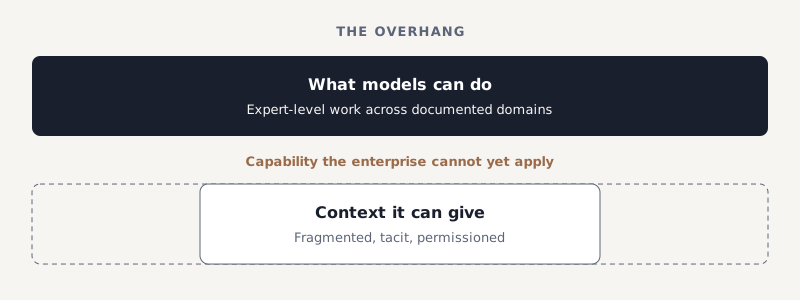
AI model capability has raced ahead of what most enterprises can productively apply. The bottleneck has shifted from model intelligence to organizational context — the fragmented, permission-scattered, tacit knowledge that lives in systems not designed for machine consumption. Organizations that solve the context problem will capture the capability overhang; those that don't will watch their technical lead diffuse slowly into the economy while competitors pull ahead.
The shift
Frontier models are now trained on nearly every domain of knowledge work. They understand esoteric legal frameworks, deep clinical pathways in healthcare and life sciences, marketing strategy, financial modeling, and anything else documented in human knowledge. For anything they don't know directly, they can pull up tools and query data sources in real time. Within two years, discrete-task expertise in most white-collar domains will be indistinguishable from — and in many cases superior to — human expert performance.
Yet outside the tech industry, and even within pockets of it, AI remains primarily a quick-answer assistant. Large work output and genuine automation is still in its infancy. As one researcher noted, even if model development stopped today, the current generation of models could still transform a substantial portion of white-collar work.
This is the capability overhang. The gap between what models can do and what enterprises have operationalized is not narrowing as fast as it should — not because the models aren't good enough, but because the environments where knowledge work happens were never built for agents.
Why it matters
The core problem was stated succinctly: context is now the bottleneck on growth, because anything with full context can be automated. The race is to make the collective brain of the organization legible to AI.
This is fundamentally different from how coding was transformed. In software development, the critical context for an agent lives inside the codebase — a single, structured, machine-readable repository. In every other domain of knowledge work, critical context is spread across fragmented systems, video calls, in-person meetings, external events, competitor moves, and tacit team knowledge that has never been written down.
Even where context is digitized, most enterprises run on legacy and fragmented infrastructure. Despite a decade of cloud migration, large unstructured data repositories still sit in on-premises systems that cannot communicate with cloud-native agents. The migration pressure will only intensify, but it is a real dependency that constrains what agents can do today.
Permissions and access controls add another layer of complexity. No two users in an organization have the same information surface — by design. A manager sees compensation data for direct reports but not peers. A consultant sees client projects but not competitors in the same firm. In an agentic world, these boundaries must be mapped onto machine identities that sometimes need broader access than any human user, and sometimes narrower. Both are hard governance problems with no off-the-shelf solution.
Finally, the technical landscape is moving so fast that enterprises are struggling to make architectural bets. Should they index into vector databases and use RAG? MCP servers from SaaS tools? Full CLI access for code execution agents? In 18 months, any one of these could be the standard — or obsolete.
The technology diffusion reality
Diffusion takes time even for the fastest-adopted technologies. Consider cloud computing: by 2010, every person in Silicon Valley knew cloud was the future. AWS had roughly $500 million in revenue. Azure had just launched. GCP was called Google App Engine. Fifteen years later, the three platforms generate roughly $225 billion — a nearly 1,000x market expansion — and still only represent about 60% of the total cloud market.
Agents will follow a similar trajectory. The capability exists. The workflows, data migration, technical literacy, change management, and governance processes do not. For any mission-critical workflow in a regulated or large enterprise, the deployment checklist is punishing: reinvent the workflow, organize the data, establish literacy, execute change management, navigate compliance, deploy governance. This is the work that takes time in the real world.
But that real-world friction is exactly why the opportunity is so large.
What to do
Invest in context engineering as a core capability. The organizations that will win are those that systematically map, digitize, and structure the tacit and fragmented knowledge their agents need to operate. This is not a one-time data migration — it is an ongoing practice of making organizational knowledge machine-legible.
Design permission systems for a 100x agent workforce. Existing IAM frameworks were built for human-scale access. Agent-scale governance requires identity models that support machine principals, scoped permissions that differ from their human sponsors, and auditable activity trails that span agent lifecycles. Start designing for this now, before the agent count outpaces the governance infrastructure.
Adopt an iterative architectural posture. The right answer for agent data access today (RAG, MCP, CLI-native, or hybrid) may not be the right answer in 12 months. Build for modularity — data sources, retrieval strategies, and agent harnesses should be swappable without rewriting the entire stack. Standardizing too early is as dangerous as standardizing too late.
Bet on the forward deployed model. Change management at enterprise scale will be heavily professional-services-driven for the foreseeable future. The teams that embed deeply with customer workflows, understand domain-specific processes, and configure agent systems within real operational constraints will be the ones that convert the capability overhang into actual deployed value. System integrators with existing enterprise relationships and the ability to evolve rapidly are not to be underestimated.
Create the manager-of-agents experience. The biggest product opportunity is making it easy for non-technical knowledge workers to manage, oversee, and direct agents — not code alongside them. Just as coding tools evolved from AI-assisted IDEs to agent oversight interfaces, every knowledge work domain (legal, finance, consulting, manufacturing) will need the same transition. The platforms that make this intuitive will win.
Be patient with diffusion, impatient with preparation. The cloud took fifteen years to reach ~60% penetration. Agentic adoption will take time too. But the preparation — context engineering, data migration, permission architecture, change management — can and should happen now, so that when the diffusion wave accelerates, you are not scrambling to catch up.